Yearly Planner, KDP: Simple, Print-Ready Design
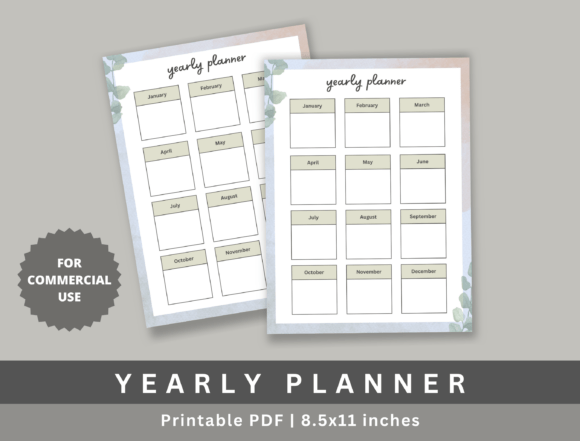
If you've ever opened a blank journal and felt both possibility and paralysis—wondering how to structure a full year without wasting time on formatting—you’re not alone. The Yearly Planner, KDP is a single-page, 8.5 x 11 inch interior graphic built specifically for Kindle Direct Publishing. It’s not software. It’s not a template you must edit in Canva or Illustrator. It’s a high-resolution PDF—professionally designed, commercially licensed, and ready to drop straight into your KDP book file.
What This Is (and What It Isn’t)
This isn’t a digital planner app. It’s not a multi-page workbook with prompts, trackers, or habit grids. It’s one clean, functional page: twelve months laid out in a balanced, visually cohesive grid—each month represented clearly but concisely, with space for notes, goals, or highlights. The layout respects KDP’s print requirements: bleed-free, CMYK-ready, and optimized for both black-and-white and color printing.
Because it’s delivered as a single PDF—not layered source files—it prioritizes reliability over customization. You won’t need design skills to use it. You won’t need to troubleshoot margins or resolution warnings before upload. That makes it especially useful if your goal is speed, consistency, or low-risk publishing—not experimental layouts.
Why Different People Reach for This—And Why They Might Pass
Beginners testing the waters of low-content publishing often start with planners because demand is steady and production feels manageable. But many stall at the technical side: aligning grids, adjusting gutters, ensuring text stays legible at small sizes. For them, the Yearly Planner, KDP removes that friction. One download. One upload. No learning curve. If your priority is launching your first KDP title in under an hour—and validating interest before investing in deeper design work—this fits.
Freelance designers and indie publishers sometimes use this as a foundation—not as a final product, but as a quality-controlled starting point. Say you’re building a themed planner series (e.g., “Mindful Year,” “Freelancer Focus,” “Teacher’s Academic Year”). Instead of redrawing monthly grids from scratch, you layer your brand colors, fonts, and subtle icons onto this base. It saves hours of alignment checks and print-test cycles—time better spent refining voice, audience targeting, or marketing copy.
Educators and school-based creators often need yearly overviews for lesson planning, parent communication, or student goal-setting. A clean, uncluttered layout lets them add their own annotations by hand—or insert it into editable slide decks or LMS pages. Because it’s print-optimized, it also works well for physical handouts: no pixelation when photocopied, no scaling surprises on letter-size paper.
Small business owners and solopreneurs may use it inside custom-branded client resources—like a “Quarterly Strategy Kit” or “Onboarding Planner.” Since it’s commercially licensed, they can include it in paid digital products without worrying about attribution or usage limits. Its simplicity also means it won’t compete with their core message; it supports structure without demanding attention.
What Matters Most—Depending on Your Goal
Your evaluation of the Yearly Planner, KDP hinges less on “is it beautiful?” and more on “does it solve *my* bottleneck?”
- Ease of use: If you’ve spent more time wrestling with KDP’s previewer than designing content, this is a relief. No layers to flatten. No fonts to embed. Just open, place, publish.
- Reliability: It’s pre-tested at 300 DPI, with safe margins and crisp vector-style lines. That matters if you’ve had books rejected for blurry text or cut-off edges.
- Commercial flexibility: You’re free to bundle it in journals, sell it as part of a bundle, or use it in client deliverables—no royalties or restrictions.
- Creativity trade-off: You gain speed and polish—but lose the ability to rearrange months, change grid ratios, or add interactive elements. That’s intentional. It’s for people who value consistency over novelty.
Real Use Cases—Not Hypotheticals
A freelance writer includes the Yearly Planner, KDP as the final section of her “Pitch & Plan” journal—a 120-page lined notebook for freelancers. She adds her logo to the cover and uses the planner page to help clients map editorial calendars. No redesign needed. Just consistent, professional scaffolding.
A yoga studio owner bundles it inside a $19 “Seasonal Reset Kit”—a printable PDF sold via her website. Her audience loves the clean aesthetic and the fact it prints perfectly on home printers. She doesn’t need animations or hyperlinks; she needs clarity and calm.
A university adjunct uses it as a teaching aid in her “Academic Project Management” seminar. Students print it, fill it in by hand during class, then scan and submit it as part of their semester planning assignment. Its uniform size and readability make grading faster—and reduce student confusion about formatting expectations.
Does This Match *Your* Next Step?
Ask yourself:
- Are you building something meant to be printed—on demand or in bulk?
- Do you want to ship fast, without hiring a designer or learning desktop publishing tools?
- Is visual cohesion more important than granular customization?
- Will this sit alongside other content (like journal prompts, reflection questions, or resource lists) where a neutral, structured backdrop helps—not distracts?
If you answered “yes” to most of those, the Yearly Planner, KDP likely serves your intent well. If you’re aiming to build an interactive Notion dashboard, a hyper-personalized habit tracker with conditional logic, or a heavily illustrated storytelling journal—that’s a different toolset entirely.
It’s also worth noting: this isn’t about replacing skill. It’s about respecting your time. Learning InDesign is valuable—but not always necessary. Investing in original illustration is powerful—but not always aligned with your current goal. Sometimes the smartest creative decision is choosing restraint: one page, one purpose, zero overhead.
That restraint is why educators use it in classrooms without tech access, why non-designers launch profitable KDP journals in a weekend, and why seasoned publishers keep it in their asset library for last-minute client requests. It doesn’t shout. It holds space. And in low-content publishing—where clarity, consistency, and compliance are quiet superpowers—that’s often enough.