Gardening Expenses Log Book KDP Interior
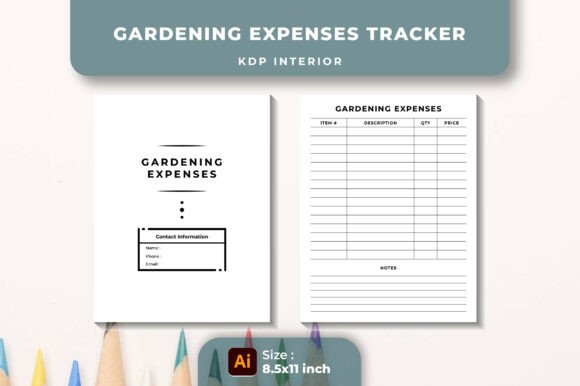
Keeping track of garden spending doesn’t have to mean scribbling receipts on napkins or losing invoices in a drawer. The Gardening Expenses Log Book KDP Interior is a purpose-built, print-ready resource designed for anyone who plants, grows, sells, teaches, or creates around gardening — and wants clarity on where their money goes.
It’s not just a blank notebook. This interior includes 120 clean, well-spaced pages (8.5 x 11 inches), optimized for both digital editing and professional printing at 300 DPI. You’ll receive editable vector files — AI, EPS, SVG, PNG, and high-res JPGs — so whether you’re customizing it for your own use, branding it for clients, or preparing it for Kindle Direct Publishing, you’re covered.
Why Tracking Garden Spending Matters — Differently for Different People
A $12 bag of compost means something entirely different depending on who’s holding the receipt.
Beginners often underestimate recurring costs: soil amendments, pest control, replacement seeds, or even the water bill during dry spells. For them, the Gardening Expenses Log Book KDP Interior acts like a gentle onboarding tool — structured enough to build consistency, flexible enough to adapt as their knowledge grows. They might start by logging monthly totals per category (seeds, tools, irrigation), then later break down costs per raised bed or crop variety.
Home gardeners with multiple plots — say, someone growing food for family meals plus herbs for small-batch salves — benefit from its clean layout and page count. They can dedicate sections to edible vs. ornamental zones, or separate personal use from items sold at a local farmers’ market. Because the source files are editable, they can add custom headers (“Tomato Trellis Build – June 2024”) or highlight seasonal spikes in fertilizer purchases.
Creatives and content creators — bloggers, YouTubers, Instagram garden educators — often need to show budget transparency for sponsorships, course development, or grant applications. With this log book, they can generate consistent, branded expense reports. One educator used the SVG files to overlay her logo and repurpose pages as printable worksheets for her “Budget-Friendly Backyard” online workshop.
Professionals & Small Business Owners: Where Precision Meets Practicality
For landscapers, market gardeners, or nursery owners, tracking expenses isn’t optional — it’s foundational to pricing, tax filing, and scaling. A freelance garden designer might use the PDF interior as-is for client project logs, then tweak the AI file to insert line-item fields for labor hours, material markups, and travel reimbursements.
The fact that it’s resizable and print-ready matters here. A small farm co-op could scale the layout to fit their internal reporting standards — adding columns for organic certification fees or equipment depreciation — without redesigning from scratch. No coding, no subscription. Just open, edit, export.
Reliability also plays a quiet but critical role. Unlike free downloadable templates that may lack bleed settings or font embedding, this interior is built for commercial print workflows. That means fewer last-minute fixes before sending to a POD service or local printer — saving time when deadlines loom.
Educators & Hobbyists: Learning Through Structure
In classroom or community garden settings, expense tracking becomes a hands-on lesson in stewardship, math, and sustainability. Middle school science teachers have used printed pages from this log book to guide students through calculating cost-per-pound of homegrown tomatoes or comparing the long-term value of drip irrigation versus overhead sprinklers.
Hobbyists who rotate crops seasonally find the 120-page length especially useful. It supports full-year logging without flipping between notebooks — and because each page is uncluttered, there’s room to jot observations alongside numbers: “Used neem oil after aphid sighting on July 12; re-applied July 19.” That kind of contextual note strengthens learning far more than raw data alone.
What Flexibility Really Looks Like
“Editable” isn’t just marketing language here — it’s functional versatility:
- Designers can adjust color palettes, fonts, and spacing in Illustrator (AI) or InDesign to match brand guidelines.
- Self-publishers can import the PDF directly into KDP, or swap in custom cover art using the included SVG assets.
- Nonprofits running urban gardening programs have added bilingual labels (English/Spanish) to the EPS file before printing bulk copies for volunteer coordinators.
- Freelancers building custom gardening dashboards sometimes extract individual page elements (like the expense summary table) as PNGs to embed in client-facing Notion or Airtable setups.
This level of adaptability means the same interior serves very different goals — from personal reflection to client deliverables — without requiring technical expertise. You don’t need to know vector math to change a label. You don’t need a design degree to resize a section header.
When This Fits — and When It Might Not
This interior shines if you value:
- Control over formatting — you prefer adjusting layouts yourself rather than relying on locked templates.
- Print-first workflows — your audience reads physical copies, or you distribute printed resources at workshops and events.
- Long-term reuse — you plan to update or repurpose the log across seasons, projects, or business models.
- Commercial flexibility — you intend to resell, bundle, or brand it as part of a larger offering (e.g., a “Garden Planning Toolkit” PDF bundle).
It’s less ideal if you only need a quick digital spreadsheet, want auto-calculating formulas, or need cloud sync across devices. Those needs point toward apps or Google Sheets — not a print-optimized interior file set.
Also, while the structure supports thoughtful tracking, it doesn’t replace financial advice. If you’re managing business taxes or applying for agricultural grants, pair this log with guidance from an accountant familiar with horticultural operations.
Making It Your Own — Without Starting From Zero
One gardener started by importing the SVG into Canva, changing the green accent to terracotta, and adding icons for “compost,” “seedlings,” and “tool repair.” She then printed 20 copies for her community garden’s volunteer team — each one pre-labeled with a plot number and season.
Another user — a freelance writer documenting her first year of flower farming — kept the original layout but added handwritten reflections in the margins: “This basil seed packet cost $4.50 but yielded 12 bouquets at $18 each.” That kind of insight only emerges when the tool gets out of the way and lets observation happen.
The Gardening Expenses Log Book KDP Interior doesn’t promise perfection. It offers space — visual, practical, and creative — to pay attention. To notice patterns. To connect effort with outcome. And to grow not just plants, but intentionality.