2025-2026 Seasonal Bee Health Tracker
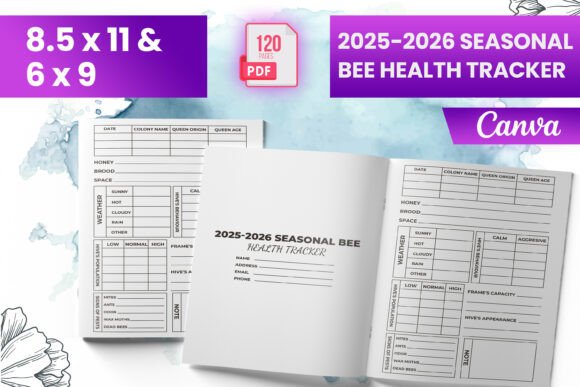
The 2025–2026 Seasonal Bee Health Tracker is a structured, printable planning and observation tool designed for beekeepers who wish to systematically record hive conditions, environmental factors, and colony behavior across the full annual cycle. It is not software or an app—it is a downloadable interior file intended for use with Amazon Kindle Direct Publishing (KDP), formatted specifically for physical journal or planner production. The tracker supports seasonal awareness by organizing data into monthly and quarterly sections aligned with typical North American beekeeping rhythms: spring buildup, summer foraging, fall preparation, and winter survival assessment.
Individuals considering this resource typically fall into two overlapping groups: hobbyist and sideline beekeepers seeking consistency in hive monitoring, and content creators or educators preparing beekeeping-themed journals for sale on KDP. Its design assumes users value hands-on recordkeeping, appreciate visual clarity, and prefer tangible tools over digital alternatives—or intend to publish such tools for others.
Why This Tracker May Be Relevant
A consistent health tracking system helps identify patterns that might otherwise go unnoticed—such as recurring varroa mite spikes in late summer, delayed brood rearing after cool springs, or nectar dearth correlations with queen loss. The 2025–2026 Seasonal Bee Health Tracker supports this by offering standardized fields for weather notes, feeding activity, swarm indicators, treatment dates, and honey yield estimates. Because it spans two full years, it also enables year-over-year comparison without requiring manual page reformatting or template recreation.
For those publishing through Amazon KDP, the tracker’s pre-tested formatting reduces technical risk. Files include bleed-ready interiors at standard US print sizes (6″ × 9″, 8.5″ × 11″), a dedicated intro page, and both PDF and raster image assets (PNG and JPG). All pages are laid out to meet KDP’s current print specifications, minimizing rejection due to margin, bleed, or resolution issues.
Key Benefits and Practical Advantages
- Time efficiency: Eliminates the need to build custom spreadsheets or hand-draw log pages—especially valuable for those managing multiple hives or teaching workshops.
- KDP compatibility: Includes files verified against Amazon’s interior requirements, reducing upload delays or formatting corrections during publishing.
- Seasonal alignment: Sections reflect real-world beekeeping phases—not generic calendar months—so entries map directly to colony development stages.
- Scalable use: Works equally well for personal recordkeeping or as a professionally formatted interior for self-published journals sold to other beekeepers.
- Print-ready flexibility: Multiple trim sizes allow adaptation to different audience preferences (e.g., portable 6″ × 9″ for field use vs. larger 8.5″ × 11″ for detailed note-taking).
Tradeoffs and Considerations
This tracker does not include interactive features—no auto-calculations, no cloud sync, and no mobile accessibility. Users must manually transcribe or interpret data if they later want to analyze trends digitally. Likewise, while the 120-page count provides ample space for two seasons of observations, it assumes one entry per hive per week. Those managing more than four hives may find page allocation tight unless they consolidate entries or use supplemental logs.
The design follows a clean, functional aesthetic optimized for readability and printing—not artistic customization. While Canva compatibility allows basic edits (e.g., font adjustments or color tweaks), deep structural changes—like adding new columns or reordering seasonal sections—require familiarity with Canva’s layout tools and may affect KDP compliance if bleed or margin settings are altered.
Also note: the tracker does not provide diagnostic guidance or treatment protocols. It records observations but does not interpret them. Users still need foundational knowledge of bee biology, pest identification, and regional forage calendars to make meaningful entries.
When This Tracker Is a Strong Fit
The 2025–2026 Seasonal Bee Health Tracker is especially appropriate when:
- You maintain 1–4 hives and want a repeatable, low-friction way to log seasonal changes without relying on apps or fragmented notebooks.
- You’re preparing a beekeeping journal for KDP publication and need a professionally structured, technically validated interior that meets current Amazon guidelines.
- Your goal is long-term pattern recognition—not immediate alerts or automated analysis—and you prefer tactile documentation methods.
- You already understand core bee health indicators (e.g., capped brood patterns, pollen stores, mite drop counts) and seek only a consistent framework to capture them.
When Alternatives May Be More Suitable
Consider other options if:
- You manage more than four hives regularly and require customizable fields per colony—dedicated hive management software (e.g., HiveTracks or BeeKeep) may offer better scalability and filtering.
- You prioritize real-time data sharing or collaborative access—for example, with mentors or club members—cloud-based tools with multi-user permissions would be more effective.
- You’re new to beekeeping and need integrated learning support—apps with embedded tutorials, photo ID guides, or region-specific forage maps provide scaffolding this tracker does not.
- You prefer minimal setup and zero formatting decisions—pre-printed physical journals sold by beekeeping suppliers may save time, though they lack the two-year span and KDP-ready flexibility.
Making an Informed Decision
Before choosing the 2025–2026 Seasonal Bee Health Tracker, ask yourself three questions:
- What is my primary use case? If your aim is personal consistency or KDP publishing, its structure and formatting serve that purpose well. If your priority is diagnostics, education, or collaboration, evaluate whether its static format supports those goals.
- What level of technical comfort do I have? Using the Canva template requires basic familiarity with uploading, editing, and exporting—especially if adjusting colors or fonts. If you plan to publish, verify that any edits preserve bleed and safe-zone margins.
- How much interpretation do I expect from the tool? This tracker organizes data; it doesn’t analyze it. You’ll still need to review entries manually—or export them to spreadsheets—to spot correlations like treatment timing versus winter survival rates.
It is neither a replacement for mentorship nor a substitute for ongoing learning about local flora, pests, and climate shifts. Rather, it functions as a neutral, durable vessel for observation—one that gains value through regular, thoughtful use across seasons.
Ultimately, the 2025–2026 Seasonal Bee Health Tracker serves best when matched to realistic expectations: a reliable, printable, KDP-aligned companion for those who understand that careful recording is the first step toward informed stewardship of honey bee colonies.